
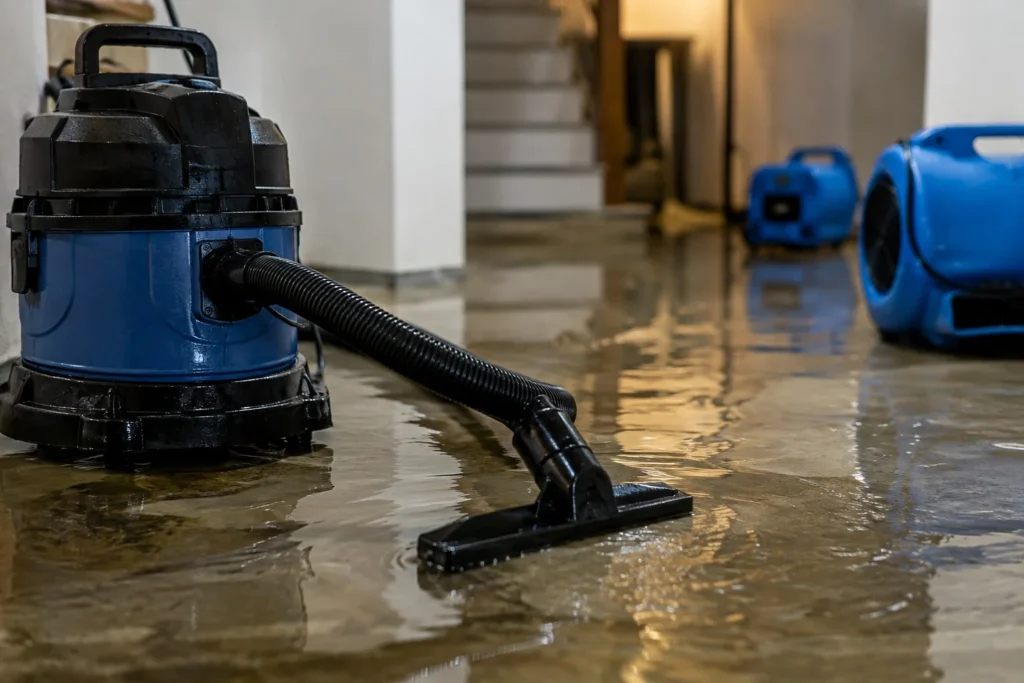
Emergency water extraction is the fastest way to stop water damage from spreading through your home. We provide 24/7 water removal in Montpelier Station and across Orange County using truck-mounted extractors and submersible pumps that pull hundreds of gallons per hour. Call (540) 360-9292 now and we will have a crew on the way.
Why Speed Matters With Standing Water
Every hour that water sits in your home, the damage gets worse and the cost goes up.
In the first hour, water soaks into carpet padding, baseboards, and the bottom edges of drywall. By hour four, it has wicked up into wall cavities and saturated subfloor materials. By hour 24, wood framing begins to swell, drywall crumbles, and in Orange County’s humid climate, mold spores start colonizing.
The difference between a $1,500 repair and a $7,000 repair often comes down to how fast the water comes out.
That is why we keep extraction equipment loaded and ready at all times. When you call (540) 360-9292 at 2 AM on a Tuesday or 6 PM on a Saturday, we are dispatching with the equipment already on the truck. We do not show up, look at the water, and tell you we need to come back tomorrow.
What Equipment Do We Use for Water Extraction?
Not all extraction equipment is the same. Here is what we bring to every emergency call in Orange County.
Truck-Mounted Extractors
Our truck-mounted units generate significantly more suction than any portable extractor. They pull water from carpet, padding, hardwood floors, and concrete at rates that portable units cannot match. For a flooded basement or a full-room pipe burst, this is the equipment that makes the difference.
Submersible Pumps
When standing water is several inches deep or more, submersible pumps go into the water and push it out through discharge hoses. We use these in basement floods, crawl space flooding, and any situation where the water level is above the capacity of surface extractors.
Weighted Extraction Tools
For carpet and padding, we use weighted extraction tools that press down into the fibers and pull water from the pad beneath. Standard vacuuming only removes surface water. Weighted extraction gets to the water hiding under the carpet where mold starts first.
Portable Extractors
For tight spaces, closets, bathrooms, and areas where truck hoses cannot easily reach, we carry portable extraction units. These are commercial-grade machines, not household wet-vacs.
Hard Surface Tools
Hardwood floors, tile, laminate, and vinyl all require different extraction approaches. We use hard surface extraction tools designed to remove water from these materials without causing additional damage from suction pressure.
How Our Emergency Water Extraction Process Works
Step 1: Emergency Assessment
We arrive and immediately identify the water source. If the source is still active, such as a burst pipe or running appliance, we stop it. If you have already shut off the water, we verify the source is controlled before starting extraction.
Using thermal imaging cameras and moisture meters, we map the full extent of the water spread. Water travels behind walls, under cabinets, and into adjacent rooms that may look dry on the surface. Our moisture map ensures we extract from every affected area, not just the visible puddles.
Step 2: Water Removal
We deploy the appropriate extraction equipment based on the volume of water, the flooring type, and the layout of the affected area. Most residential extractions use a combination of truck-mounted extractors for the main area and portable units for tight spaces.
For a typical burst pipe affecting two rooms, extraction takes 1 to 3 hours. For a full basement flood, it can take 3 to 6 hours depending on the water volume and access.
Step 3: Moisture Detection
After visible water is removed, we take moisture readings throughout the affected area using calibrated moisture meters and thermal imaging. This step catches hidden moisture in wall cavities, under cabinets, behind baseboards, and in subfloor materials.
These readings become the baseline for the structural drying phase that follows extraction.
Step 4: Transition to Drying
Once extraction is complete, we set up LGR dehumidifiers and air movers to begin structural drying. This equipment stays in place for 3 to 5 days on average, and we take daily moisture readings until every material reaches dry standard per IICRC S500 guidelines.
If you only need extraction and can handle the drying yourself with household fans and a dehumidifier, we will tell you that. For small spills and minor leaks, professional drying is not always necessary. We would rather be honest with you than run up a bill you do not need.
Common Emergencies We Respond To in Orange County
Burst Pipes
The most common emergency call we get, especially between November and March when freeze-thaw cycles stress older plumbing. Many homes in Montpelier Station and along Route 20 still have galvanized steel or polybutylene pipes that fail under thermal stress. A single burst supply line can release 4 to 8 gallons per minute. That is 240 to 480 gallons in the first hour. [Learn more about burst pipe water damage repair.]
Flooding From Storms
Orange County receives 43 to 47 inches of rainfall per year. When a heavy spring storm or summer thunderstorm drops 3 to 4 inches in a few hours, the clay-heavy Piedmont soil cannot absorb it fast enough. Water pools around foundations and enters basements through floor joints, wall cracks, and window wells. [Learn more about storm and flood damage restoration.]
Appliance Failures
Water heaters, washing machines, dishwashers, and refrigerator ice maker lines all fail eventually. When they do, they can release water for hours before anyone notices, especially if the failure happens while you are at work or asleep.
Sump Pump Failures
If you have a sump pump in your basement, it is the last line of defense against groundwater intrusion. When it fails during a rain event, water rises quickly. We respond to sump pump failure floods throughout Orange County, from the Town of Orange to Locust Grove.
Sewage Backups
Sewage backups involve Category 3 black water that requires full personal protective equipment and thorough sanitation. Do not attempt to clean sewage water yourself. [Learn more about sewage cleanup in Montpelier Station.]
How Much Does Emergency Water Extraction Cost?
Emergency water extraction in the Montpelier Station and Orange County area typically costs between $500 and $3,000 depending on the volume of water, the size of the affected area, and the time required.
Here are ballpark ranges:
- Single room, minor flooding (appliance leak, toilet overflow): $350 to $800
- Two to three rooms, moderate flooding (burst pipe, water heater failure): $800 to $2,000
- Full basement flood: $1,500 to $3,500
- Major multi-room flood (storm damage, main line break): $2,500 to $5,000+
These estimates cover extraction only. Structural drying, mold treatment, and material repairs are separate costs depending on the extent of damage.
Your homeowner’s insurance typically covers emergency water extraction for sudden, accidental events. A burst pipe, a failed water heater, or a washing machine hose that blows are generally covered. We document everything with timestamped photos and moisture readings that your adjuster needs for claim processing.
Need emergency water extraction right now? Call (540) 360-9292. We answer 24/7.
Why Orange County Homeowners Call Us for Emergencies
We are already in Orange County. The nearest franchise competitors dispatch from Charlottesville, Richmond, or Fredericksburg. By the time they drive 30 to 60 miles, your damage has gotten worse. We respond from Montpelier Station along Route 20 and can reach any point in Orange County in under 20 minutes.
We arrive with equipment. Every truck carries extractors, pumps, dehumidifiers, air movers, moisture meters, and thermal cameras. We do not waste your time with a look-and-come-back visit.
We are IICRC certified. Our technicians hold Water Damage Restoration Technician (WRT) certifications and follow IICRC S500 standards for every extraction. This is not a side job. This is what we do.
We tell you the truth. If your situation is minor enough to handle with towels and a box fan, we will tell you that on the phone. We want to be the company you trust and call when you really do need us.
Areas We Respond To for Emergency Calls
We respond to emergency water extraction calls across all of Orange County and into adjacent counties:
- Montpelier Station (immediate response)
- Town of Orange (5-10 minutes)
- Gordonsville (10-15 minutes)
- Barboursville (10 minutes)
- Somerset, Rapidan, Unionville (10-15 minutes)
- Locust Grove, Lake of the Woods (15-20 minutes)
- Mine Run, Wilderness (15-18 minutes)
- Liberty Mills, Burr Hill, Rhoadesville (8-18 minutes)
- Culpeper County, Madison County, Greene County (25-30 minutes)
[See all areas we serve.]