
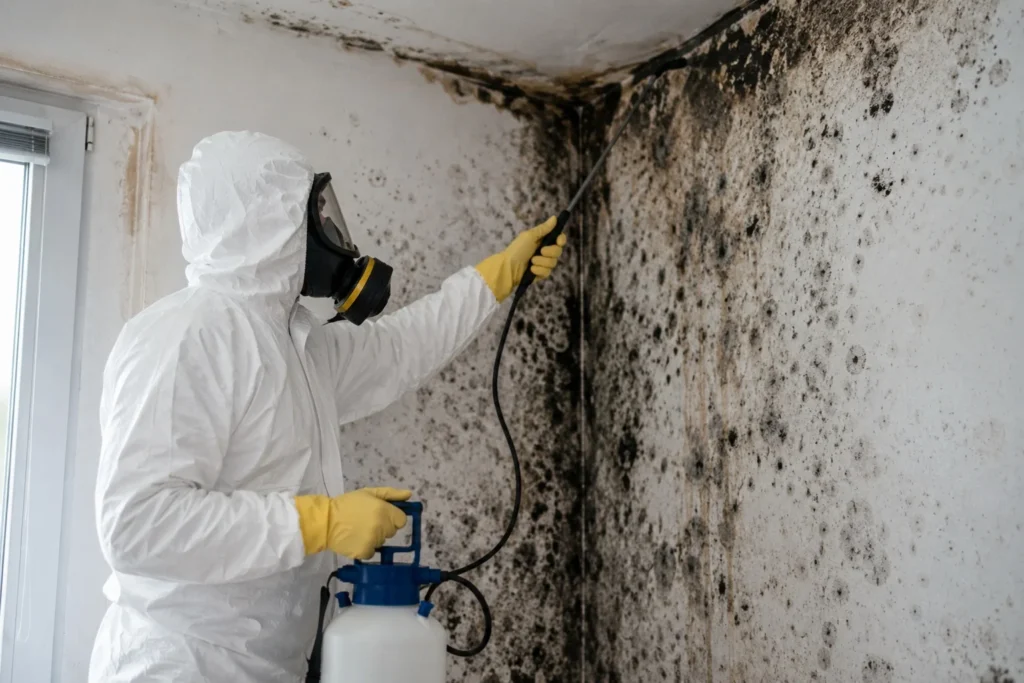
Mold remediation is the controlled removal of mold contamination from your home following IICRC S520 standards. In Montpelier Station and across Orange County, Virginia’s humid subtropical climate creates conditions where mold can colonize within 24 hours of any water event. Our AMRT-certified technicians provide full containment, HEPA filtration, mold removal, antimicrobial treatment, and post-remediation clearance testing. Call (540) 360-9292.
Why Mold Is a Bigger Problem in Orange County Than Most Places
Mold spores exist everywhere. They are in the air you breathe right now, indoors and out. The issue is not the spores. The issue is giving them moisture and a food source, which is any organic material like drywall paper, wood, carpet backing, or insulation.
Orange County’s climate provides the moisture side of that equation more aggressively than most areas.
High Annual Humidity
Summer humidity in Orange County regularly exceeds 70%. On many July and August days, relative humidity inside a home can reach 60% or higher even with air conditioning running. The EPA recommends keeping indoor humidity below 60% to prevent mold growth, and below 50% is ideal. In a Virginia Piedmont summer, staying below those levels takes active effort.
Above-Average Rainfall
With 43 to 47 inches of annual rainfall, Orange County gets more rain than the national average. Heavy spring storms and summer thunderstorms create water intrusion events that introduce moisture into wall cavities, basements, and crawl spaces where it may not be visible.
Crawl Space Moisture
Many homes in Orange County, particularly rural properties between Rapidan and Barboursville, have crawl spaces built directly over clay soil. Warm, moist summer air enters the crawl space, meets cooler surfaces below the floor, and condenses. This creates a chronic moisture environment where mold thrives year-round if the space is not properly encapsulated.
Older Home Construction
Homes built before the 1980s throughout the area often lack modern vapor barriers, adequate ventilation, and sufficient insulation. These construction characteristics allow moisture to accumulate in wall cavities and attic spaces where it feeds mold growth for months or years before anyone notices.
Signs of Mold in Your Home
Mold is not always visible. Here are the signs Orange County homeowners commonly report before mold is discovered:
- Musty smell that does not go away with cleaning or airing out the space
- Visible discoloration on walls, ceilings, or around window frames, ranging from black and green spots to white or gray fuzzy patches
- Peeling or bubbling paint on walls and ceilings, indicating moisture trapped behind the surface
- Warped or buckled flooring from moisture beneath the surface
- Worsening allergy symptoms when spending time indoors, particularly sneezing, congestion, watery eyes, or respiratory irritation
- Soft or crumbling drywall that feels damp to the touch
- Past water damage that was never professionally dried, even if the area looks dry now
If you have had any water event in your home, from a small leak under a sink to a full basement flood, and professional drying was not performed, there is a reasonable chance mold has developed in the affected area.
Our Mold Remediation Process
We follow IICRC S520 standards for every mold remediation project. This is not a spray-and-pray approach. It is a controlled, documented process that produces verifiable results.
Step 1: Inspection and Assessment
We identify the extent of mold contamination using visual inspection, moisture meters, and thermal imaging. We determine the water source that caused the mold and confirm it has been resolved. Mold remediation without fixing the moisture source is a waste of your money because the mold will return.
Step 2: Containment
We isolate the affected area using polyethylene sheeting and negative air pressure to prevent mold spores from spreading to unaffected parts of your home during removal. Negative air machines with HEPA filtration run continuously throughout the remediation process, maintaining pressure differentials that keep contaminated air flowing into the work zone, not out of it.
Step 3: HEPA Air Filtration
HEPA air scrubbers filter particles down to 0.3 microns, capturing mold spores from the air. These units run during and after remediation to clean the air in both the work zone and surrounding areas.
Step 4: Mold Removal
Affected materials that cannot be cleaned are removed. Porous materials like drywall, carpet, insulation, and ceiling tiles that have mold contamination are cut out and disposed of following proper waste handling procedures. Non-porous and semi-porous materials like wood framing, concrete, and metal are cleaned using appropriate methods including HEPA vacuuming, damp wiping, and media blasting where necessary.
Step 5: Antimicrobial Treatment
After removal and cleaning, we apply EPA-registered antimicrobial treatments to all surfaces in the remediation area. This kills remaining spores and provides a protective barrier against future growth.
Step 6: Drying and Humidity Control
If moisture levels are still elevated, we set up LGR dehumidifiers and air movers to bring the area to proper dry standard. Mold cannot grow without moisture, so this step is your best long-term protection.
Step 7: Post-Remediation Clearance Testing
After remediation is complete, clearance testing confirms that mold levels in the remediated area are at or below levels found in unaffected areas of the home and outdoor ambient air. This is the verification step that proves the work was done correctly.
How Much Does Mold Remediation Cost in Orange County?
Mold remediation cost depends on the size of the affected area, the type of materials involved, and whether structural work is needed.
Typical ranges for residential mold remediation in Orange County:
- Small area (under 10 square feet, surface mold on a wall or ceiling): $500 to $1,500
- Moderate area (10 to 100 square feet, one to two rooms with mold in drywall/framing): $1,500 to $5,000
- Large area (100+ square feet, multiple rooms, crawl space, or attic mold): $3,000 to $10,000
- Extensive contamination (structural involvement, HVAC contamination, whole-house): $8,000 to $20,000+
Insurance coverage for mold remediation varies. If the mold resulted from a covered water damage event (burst pipe, appliance failure), your insurance may cover the remediation as part of the overall claim. Mold from chronic moisture, deferred maintenance, or pre-existing conditions is typically not covered. We can help you understand your coverage before work begins.
Concerned about mold in your home? Call (540) 360-9292 for an assessment.
Mold Prevention in Virginia’s Humid Climate
After remediation, preventing mold from returning requires controlling moisture.
- Fix water intrusion sources immediately. A dripping pipe, a slow roof leak, or condensation on ductwork are all mold invitations.
- Keep indoor humidity below 50% during summer months. A whole-home dehumidifier or properly sized HVAC system is the most effective approach.
- Encapsulate crawl spaces. A vapor barrier, sealed vents, and a crawl space dehumidifier turn a moisture chamber into a controlled environment. [Learn more about crawl space moisture control.]
- Ventilate bathrooms and kitchens with exhaust fans that vent to the outside, not into the attic.
- Run bathroom fans for 20 minutes after showering.
- Check your home after any water event. Even a small leak under a sink can produce mold in the cabinet backing within days during summer.