
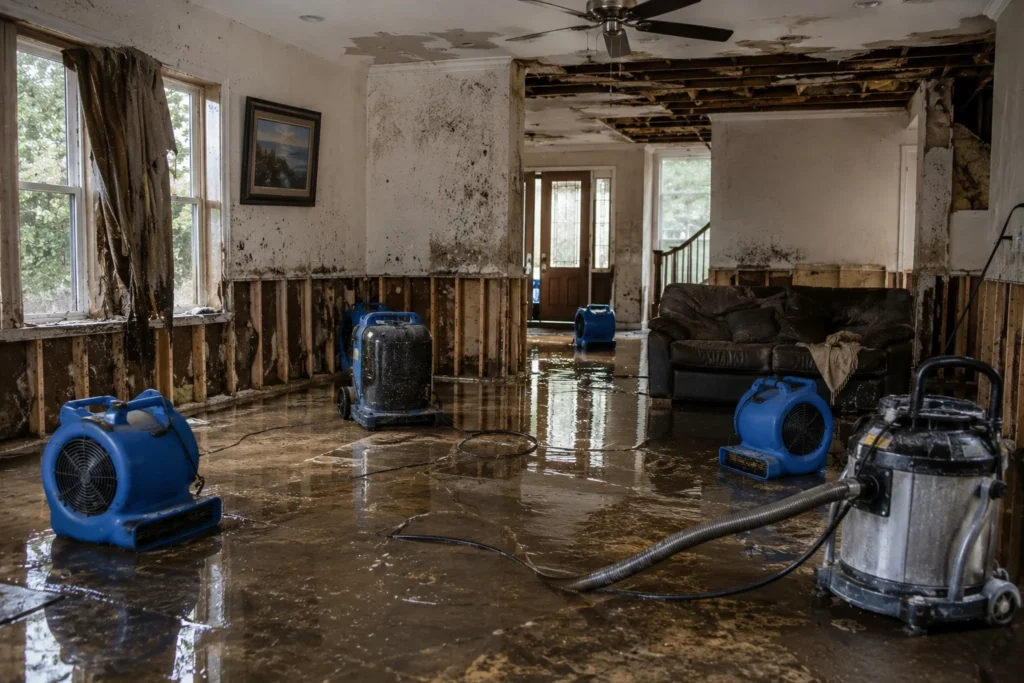
Storm and flood damage restoration in Montpelier Station covers everything from emergency water extraction after a severe thunderstorm to full structural repair following a major flooding event. Orange County’s position in the Rapidan River basin, its clay-heavy Piedmont soils, and its documented history of severe weather events make storm damage a reality for homeowners across the area. Call (540) 360-9292 for 24/7 emergency response.
Storm and Flood History in Orange County
Central Virginia is not immune to severe weather. Orange County has a documented record of major storm and flood events going back decades.
The remnants of Hurricane Camille in August 1969 produced 12 to 20 inches of rainfall across central Virginia in just 3 to 5 hours. The flooding that followed was some of the worst in the state’s recorded history.
Hurricane Agnes in June 1972 dropped 5 to nearly 15 inches across central and western Virginia. Major flooding affected communities throughout the Piedmont region.
In June 1995, thunderstorms produced over 10 inches of rainfall in the Rappahannock and James River basins. Madison County, directly northwest of Orange County, recorded 20 inches in 12 hours.
Hurricane Fran in September 1996 brought up to 16 inches of rain to parts of western Virginia, with significant flooding across the central Piedmont.
The Rapidan River, which borders Orange County to the south, has recorded 61 flood events since 1930 at the Culpeper gauge. This is an active flood zone, and properties near the river and its tributaries carry elevated risk.
Most recently, severe storms in May 2018 dumped over 7 inches of rainfall across the Orange area, nearly double the normal May average. Roads flooded, bridges were temporarily closed, and homes throughout the county experienced water intrusion.
These are not once-in-a-lifetime events. Heavy storms that produce flash flooding hit this region every few years. The question is not whether it will happen again but when.
Types of Storm Damage We Handle
Flash Flooding
When heavy rain overwhelms drainage systems, water enters homes through foundation cracks, basement windows, door thresholds, and garage openings. Flash flooding often involves large volumes of water contaminated with soil, debris, and organic matter, classifying it as Category 2 (gray water) or Category 3 (black water) depending on the source.
Roof and Window Intrusion
High winds, hail, and fallen branches can damage roofing materials and window seals, allowing rainwater into attic spaces, wall cavities, and living areas. The damage from roof leaks can be deceptive because water follows unexpected paths along rafters, sheathing, and wiring before emerging through a ceiling that may be far from the actual point of entry.
Fallen Trees
Trees that fall on homes during storms can breach the building envelope entirely, exposing interior spaces to direct rainfall. These situations require emergency tarping to prevent ongoing water intrusion while structural repairs are planned.
Saturated Landscaping and Foundation Pressure
Even without visible flooding, a major storm can saturate the clay soil around your foundation to the point where hydrostatic pressure pushes water through walls and floor joints. This type of water intrusion may not appear until hours or even a day after the storm passes.
Power Outage and Sump Pump Failure
Storms and power outages go hand in hand. If your basement relies on a sump pump, a power outage during a heavy rain event means the pump stops working precisely when you need it most. [Learn more about sump pump failure.]
Our Storm Damage Restoration Process
Emergency Tarping and Securing
If your roof or building envelope has been breached, we install emergency tarps and board-ups to prevent further water intrusion while permanent repairs are arranged.
Water Extraction
We deploy submersible pumps for standing water and truck-mounted extractors for saturated carpets, flooring, and surfaces. Storm floodwater often contains silt, debris, and contaminants that require additional extraction passes.
Contamination Assessment
Floodwater from outside the home is typically Category 2 or Category 3 water. This means any porous materials contacted by the water, including carpet, padding, drywall, insulation, and upholstered furniture, may need to be removed rather than dried in place. We assess the contamination level and determine what can be saved versus what must be replaced.
Structural Drying
LGR dehumidifiers and air movers dry the remaining structure. Storm damage drying often takes longer than pipe burst drying because more area is typically affected and the materials may have higher starting moisture content.
Mold Prevention
We apply antimicrobial treatments to all affected surfaces. After a storm flood, mold prevention is critical because the water often carries organic material that accelerates mold colonization. [Learn more about mold remediation in Montpelier Station.]
Debris Removal and Cleanup
Storm damage often involves mud, silt, leaves, and debris that need to be removed before drying and restoration can begin. We handle full debris cleanup as part of the restoration process.
Repair and Restoration
We replace all damaged materials including drywall, insulation, flooring, trim, and structural components as needed. The goal is to return your home to its pre-storm condition.
Insurance and FEMA Assistance for Storm Damage
Storm damage insurance coverage depends on the specific cause.
Wind and rain damage from storms is generally covered by standard homeowner’s insurance. If wind damages your roof and rain enters through the breach, that is a covered event.
Rising floodwater from rivers, streams, or surface runoff is NOT covered by standard homeowner’s insurance. This requires a separate National Flood Insurance Program policy. Orange County participates in NFIP as Community No. 510203. Effective floodplain maps have been in place since May 17, 2022.
FEMA assistance may be available after presidentially declared disasters. FEMA assistance typically comes in the form of low-interest loans and grants, not full restoration coverage. It is not a substitute for adequate insurance.
We document all storm damage thoroughly with photos, moisture readings, and detailed scoping reports for your insurance claim. We use Xactimate estimating and work directly with your adjuster to facilitate the process. [Learn more about insurance claim assistance.]
How Much Does Storm Damage Restoration Cost?
Storm damage costs vary widely depending on severity:
- Minor storm intrusion (small roof leak, limited area): $800 to $2,500
- Moderate storm damage (multiple rooms, foundation intrusion): $2,500 to $7,000
- Significant flooding (basement or ground floor, debris, contamination): $5,000 to $15,000
- Major event (structural damage, roof breach, whole-floor flooding): $10,000 to $30,000+
Storm damage to your home? Call (540) 360-9292 right now. We respond 24/7.]
How to Prepare Your Orange County Home for Storm Season
- Clean gutters and downspouts before spring and fall. Extend downspouts at least 6 feet from your foundation.
- Trim trees near your home. Dead branches and leaning trees are the most common source of storm damage to roofing.
- Inspect your roof for damaged or missing shingles, cracked flashing, and deteriorated sealant around vents and chimneys.
- Test your sump pump and install a battery backup.
- Know your flood zone. Check your property’s flood risk through FEMA’s flood map service. Properties near the Rapidan River, North Anna River, and their tributaries are at higher risk.
- Consider flood insurance. Standard homeowner’s insurance does not cover rising floodwater. An NFIP policy typically has a 30-day waiting period before coverage begins, so do not wait until a storm is forecast.
- Keep important documents and irreplaceable items above potential flood level or in waterproof containers.